
PV column
Photovoltaic
2026/09/24
Households can save as plug-in solar panels come to market (DESNZ, U.K.)
The Department for Energy Security & Net Zero (DENSZ) of the UK, an island nation like Japan, published a press release titled “Households can save as plug-in solar panels come to market” on August 26, 2026.
Legal frameworks for plug-in solar systems are being established in many countries, and their adoption is progressing.
In this column, we will introduce the contents of this press release and the full guidance on installing panels and permission by DENSZ, U.K.
Source (press release): https://www.gov.uk/government/news/households-can-save-as-plug-in-solar-panels-come-to-market
Source (guidance): https://energysavingtrust.org.uk/plug-in-solar-panel-checklist
**********
From: Department for Energy Security and Net Zero, The Rt Hon Miatta Fahnbulleh MP and Martin McCluskey MP
Published: 26 August 2026
Households can save hundreds on bills as plug-in solar panels become legal to use and buy across the country.
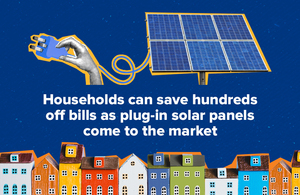
- Plug-in solar panels now legal to buy and use across the country
- Households could save up to £110 a year, with panels providing up to 20% of average home electricity use
- Savings follow government cuts to VAT on energy bills to offer breathing space this winter。
More families are set to save money on bills as plug-in solar panels become legal across Great Britain.
From today (27 August), the easy-to-install panels can be plugged into homes across the country, saving households up to £110 a year on their bills through clean, homegrown power.
Each plug-in solar kit produces up to 800W of power, enough to provide up to 20% of an average home’s electricity use. This can run a typical fridge, television, Wi-Fi router, laptop, phone charger and an Xbox S operating at once when the sun is shining.
This all comes with no installation cost and without taking any electricity from the grid.
The legal changes follow rigorous, independent safety testing, covering all key electrical elements, which shows that compliant panels are safe and compatible with UK wiring.
The UK safety specification is more stringent than that of Germany, where the technology is already widely used and around half a million new devices were plugged in last year.
Homegrown power is the only way to deliver energy security for the country and financial security for families and businesses.
Energy Secretary Miatta Fahnbulleh said:
“Plug-in solar is a simple, affordable way for households to take control of their energy bills and start saving straight away.
“From this summer, we’re giving more families the ability power their homes with clean homegrown energy.
Major retailers, such as Currys, B&Q, Screwfix and Amazon have worked with government on the rollout of plug-in solar and will soon have them available to purchase in stores and online.
The low-cost panels can be put in any outdoor space or on some balconies. Before purchasing or installing plug-in solar devices, people should check whether any permissions are required for the property. This may include permission from a landlord and/or building owner or freeholder permission, planning permission or listed building consent.
Decisions on whether to approve requests are a matter for landlords, freeholders or councils, but we encourage them to consider each case on its individual merits.
Enabling these easy-to-install panels is just one of the ways the government is giving people breathing space to help tackle bills.
In July, the Prime Minister announced plans to cut VAT on energy bills to give families breathing space this winter. This builds on the £150 of costs taken off energy bills in the Budget last year and the expansion of the £150 Warm Home Discount to around six million households.
Retailers including Amazon, Argos, Curry’s and Wickes have all committed to stocking plug-in solar panels.
John Boumphrey, UK & Ireland Country Manager, Amazon said:
“Amazon is the largest corporate buyer of carbon-free energy in the UK, and we’ve invested in 50 solar and wind projects to date.
“The government’s announcement on plug-in solar panels is a practical step that gives households a simple way to generate their own power, reduce bills, and contribute to the UK’s net zero goals. We’re looking forward to helping customers benefit from this technology.
Graham Biggart, Managing Director for Argos, said:
“We’re really pleased to now offer plug-in solar panels for Argos customers. By making this technology more accessible, we’re putting more power in the hands of our customers and helping them explore practical ways to manage energy use at home.
“As a brand trusted by millions of customers across the UK, we’re proud to bring innovative products like this to more homes and give customers greater confidence and choice when it comes to emerging home technologies.
Michelle Gorringe-Smith, Director of New Categories at Currys, said:
“The safe roll-out of plug-in solar products represents an important step in supporting consumers with ways to save money on their energy bills.
“We’ll continue to work closely with DESNZ and our suppliers to make these products available to UK households as soon as possible, including through both our website and larger stores.
David Wood, CEO, Wickes:
“By giving people a simpler and more affordable way to generate clean energy at home, this technology has the potential to put solar within reach of many more households.
“With the UK having some of the oldest and least energy efficient housing stock in Europe, making energy-saving technologies easier to access will be an important part of helping people reduce their energy bills and supporting the transition to a lower-carbon future.
“We look forward to making these products available online to our customers in the coming weeks.
Joanna O’Loan, Knowledge Manager at Energy Saving Trust, said:
“The arrival of plug-in solar panels represents a significant milestone in expanding access to clean energy for households across Great Britain.
“While the savings will vary from home to home, plug-in solar panels will give more people greater control over their energy use and costs. As these products become more widely available, access to clear and reliable information is essential to help people make informed choices that are right for their home and budget.
Chris Hewitt, CEO Solar Energy UK, said:
“This is a great example of Industry and government coming together and delivering quickly for Britain.
“Solar and batteries are already the most effective way for homes and businesses to slash their energy bills by more than half, and making plug-in solar lawful will bring cheap, clean power to households that have not been able to access these benefits before.
“Our industry continues to work closely with government to ensure that all customers can have confidence in the safety and reliability of these new technologies.
Gary Booker, Managing Director of British Gas, said:
“Until now, generating solar power has required the right roof, the right home and significant upfront investment. That’s why innovations like plug-in solar are so important. They open up the benefits of solar to more households, enabling more people to produce some of their own electricity.
“At British Gas, we’re pleased to be bringing this technology to our customers, giving them more control over their energy use and helping them save money on their bills.
Trevor Hutchings, CEO of the Renewable Energy Association said:
“From today, with little more than a trip to the shops, people in Britain will be able to harness the energy of the sun to power their households.
“The arrival of plug-in solar is a huge step forward in democratising renewable energy and giving everyone the access they deserve to clean, cheap, homegrown power. Plug-in solar saves money – up to £100 a year – and it’s only right that this benefit should be felt by renters and flat-owners as well.
“Our electricity prices are some of the highest because of our exposure to volatile international gas markets. Innovations like plug-in solar and the wider renewables roll out will help us bring down bills and strengthen our energy sovereignty.
David Boyer, Director of Electricity Systems, at Energy Networks Association, said:
“This is a major step forward for incorporating micro generation safely and efficiently onto the UK’s energy grid. Network operators will continue to work closely with government, Ofgem and manufactures to ensure the registration process for micro generation evolves to meet consumer demands.
There is already record demand for solar power across the country. Figures released by MCS recently showed there were almost 150,000 solar panel certified installations in the first six months of 2026, up 17% on the previous highest start to a year in 2025. That is the equivalent to an installation every 74 seconds.
Battery installations have also risen significantly, with installations almost double the same period last year with 36,000 certified installations.
Legalising plug-in solar panels builds on savings homeowners can already make of up to £480 a year from rooftop solar, helping more people in a range of property types generate their own clean electricity and cut their energy bills.
Notes to Editors
We encourage the public to consult the full guidance on installing panels and permissions which may be required for their property.
See a list of accredited devices and manufacturers.
Read the full MCS dataset.
Next, I would like to introduce “the full guidance on installing panels and permissions which may be required for their property” as follows:
**********
Plug-in solar panels: Checks to make before you buy
Already bought plug-in solar panels? Make sure you register your device.
At a glance
- Check whether you need permission to install plug-in solar panels before you buy.
- Make sure your property and electrics are suitable.
- Install the panels safely and register your system after installation.
If you live in England, Scotland or Wales, plug-in solar will be available to buy from 27 August 2026. Northern Ireland may follow once regulations are updated. Use this guide to help you find out more, including about getting permissions depending on where you live.
Plug-in solar panels are a lower cost way to generate electricity than rooftop solar panels.
Make sure you buy a UK-compliant plug-in solar panel device from a registered seller. And before you buy, make sure you’re able to install the plug-in solar panel device safely and legally.
Since plug-in solar is new to the UK, we appreciate you may have more questions. If you have a question that isn’t answered here, get in touch. We’ll collect all questions related to plug-in solar panels with an aim to update this guide as more information becomes available.
Want to know more about plug-in solar panels? Read our plug-in solar panel beginners’ guide.
1. Check if you need permission to install plug-in solar panels
Don’t buy plug-in solar panels before getting relevant permissions.
If you buy and install a plug-in solar panel without relevant permission, you may be required to remove the panels and pay for any damage caused. This is the same as with satellite dishes, EV charge points and air conditioning units.
Tenants, leaseholders, residents of managed buildings
Get permission from whoever’s responsible for the building before buying. This could be your landlord, freeholder or building manager (property manager in Scotland). It’s worth getting explicit permission if you:
- Plan on drilling into walls to install brackets.
- Need to install an external mains socket for your plug in-solar panel device.
If you own your own flat, check your lease agreement for:
- Needing permission to fix equipment to your balcony, external walls, roof, railings or communal areas.
- Restrictions that could impact the building’s fire safety or insurance.
- Restrictions on making alterations to the outside of the building or communal areas.
Do I need planning permission?
Depending on where you live, you may need planning permission before installing:
- England: Planning Portal
- Scotland: ePlanning Scotland
- Wales: Planning Portal
For England – the UK Government has introduced a Permitted Development Right to make it easier to install plug-in solar panels on houses.
For Scotland – check the requirements that apply in your area before installing.
For Wales – check the requirements that apply in your area before installing.
For Northern Ireland – Plug-in solar panels aren’t currently permitted for use.
If you live in a listed building or conservation area, check with your local authority or planning office to see if you need planning permission.
Safety requirements and insurance
Check with your local authority about any building, fire or electrical safety concerns or legal requirements before you buy.
You should also contact your buildings and contents insurance provider to see how plug-in solar panels might affect your policy. Check whether your policy includes outdoor installations.
2. Check that your property and electrics are suitable
These are some essential questions before installing any plug-in solar panels:
Is my location suitable?
Plug-in solar panels work best on an unshaded, south-facing spot.
Panels facing east or west still work but will generate less electricity. We don’t recommend installing panels that face north or are in a shaded space.
Is my building suitable?
Flats, apartments and ‘higher-risk buildings’ may have other rules due to fire safety concerns. They may need to consider how the installation affects the building’s fire risk assessment.
The definition of a higher-risk building varies across UK nations. If you’re not sure whether your building qualifies, check with your local authority or building manager (property manager in Scotland).
Does the building have external cladding or timber balconies, or is undergoing work on the external walls?
Speak to your building manager (property manager in Scotland) before installing plug-in solar panels, as these could impact fire safety. This is particularly important if your building has combustible cladding or has undergone remediation work.
Do I have a suitable socket to plug the panels into?
Plug-in solar panels need to be plugged in directly to a mains socket. This is ideally an outside socket, but it could be inside.
You can’t use an extension lead, so your choice of location is important. The length of the cable is also important as you need to make sure it will reach directly into a socket. The socket has to be in a circuit that doesn’t have lighting or hardwired appliances e.g. a boiler or cooker.
Outdoor sockets need to be weatherproof and installed by a qualified electrician.
Is my electrical system suitable?
You should have your electrical system inspected every 10 years (every five years for tenants) to make sure it’s modern and safe.
Speak to a qualified electrician if:
- Your electrical consumer (fuse box) unit has older, rewireable fuses.
- You’re not sure about the condition of your wiring.
- You need to move or install a new socket.
- If the total power of the solar panels is more than 960W.
You can find local, qualified electricians using Trustmark – a government-endorsed quality scheme.
Are my plug-in solar panels compliant with UK standards?
Make sure the specific model you’re looking at is on the list of devices that meet UK standards. You can look for your model on the ENA Connect Direct LCT Device Register.
Other considerations
Make sure you’re aware of any specific considerations regarding your plug-in solar panels, including:
- warranties
- insurance
- repairs
- theft
- disposal and recycling
For more information, check the product information on the panels you want to buy.
3.Install the plug-in solar panels safely
Make sure you install your plug-in solar panels in line with the manufacturer’s instructions.
There are also several safety considerations to keep in mind:
Building safety
- Use an appropriate frame, fixing or anchors so the panels are secure and can’t move or blow over during strong winds. Don’t install plug-in solar panels on wooden fences unless you get advice from a professional to ensure that it’s safe.
- If you’re installing panels on a garage or outbuilding, make sure the roof is strong enough to take the weight of the panels. If you’re unsure, get professional roofing advice.
- Take care when drilling into walls to install brackets. Be aware of pipes or cables in the walls, and suitable seals where needed to prevent damp and mould.
- Any fixtures should be non-permanent and shouldn’t damage the building, affect fire safety or damage any weatherproofing. If installing the panels does impact these areas, it may be classed as ‘building work’. This means you’ll need to adhere to Building Regulations, even if formal consent is not required. This varies across UK nations. Check with your local building control before installation for advice.
- Make sure you keep all cables tidy and secure to avoid trip hazards or accidental disconnection.
Electrical safety
- Only connect one plug-in solar panel device per property.
- Use a socket that’s connected to a circuit that doesn’t also control lighting or hardwired appliances e.g. a boiler or cooker. To find out which circuits are suitable, switch off one circuit breaker at a time and check which appliances are affected. If you’re unsure, speak to a certified electrician.
- Plug the panels directly into a suitable socket (indoor or outdoor). Don’t use extension leads, international adaptors or altered plugs.
- If your socket is outdoors, make sure the socket is suitable for outdoors and installed by a qualified electrician. A rating of at least IP65 means that it’s adequately protected against water and dust.
- Don’t modify the device or link multiple devices together. You might read this being called ‘daisy-chaining’.
- Test your circuit breaker protection every six months by pressing the ‘test’ button on your electrical consumer unit, if you have one. Do this during the daytime while the panels are generating electricity. If the circuit breaker doesn’t trip, unplug the device and speak to a qualified electrician.
4. Register your plug-in solar panels
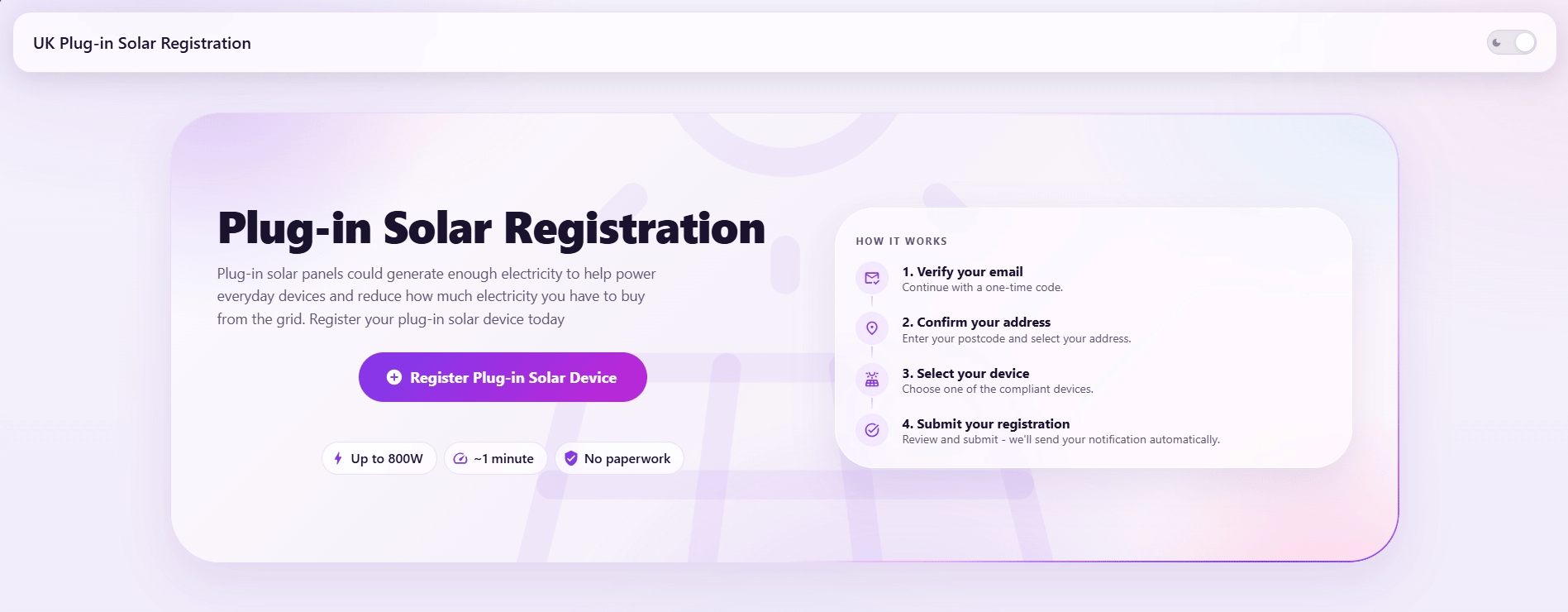
It’s important to register your device using the UK Plug-In Solar Registration website.
Registering your plug-in solar panels is a legal requirement. It also ensures the energy network can handle the extra electricity flowing into the system.
To register your device, you’ll need:
- your name
- your postcode
- the make and model of the device
Frequently asked questions
Q1. Why can I only plug in one solar device per property?
A1. This is due to current regulations. This restriction may change in future, but the regulations need to be updated to allow this.
Q2. I own a flat in Scotland and there is no freeholder to seek advice from. Who should I approach?
A2. If you have a property factor then it would be best to approach them in the first instance. If you do not have a factor then the local authority may be able to assist on statutory compliance.
Q3. I’ve read that plug-in solar panels are capped at 800W. Why does this guide mention devices over 960W?
A3. The current regulations say that 800W is the maximum amount of power allowed to enter your home’s electrical socket. All compliant devices sold in the UK are capped at 800W.
However, the panels themselves may be able to generate more than that. For example, if your plug-in solar panel device includes two panels of 450W each.
If this happens, the microinverter connected to the panels limits the maximum output to 800W. Some manufacturers call this ‘clipping’.
Q4. Can I install plug-in solar panels if I already have rooftop solar panels and/or a battery installed?
A4. This is usually possible. You should speak to the original installer or a qualified electrician to check that your new plug-in solar panels won’t overload your system. You may need to notify your Distribution Network Operator (DNO) if adding the plug-in solar panel device means your home is exporting electricity over a certain amount.
Q5. Can I repair plug-in solar panels myself?
A5. No. You should never attempt to repair the panels or the inverter yourself. Report any faults to the manufacturer.
Q6. How do I recycle plug-in solar panels?
A6. Solar panels are classed as Waste Electrical and Electronic Equipment (WEEE), which need to be recycled by specialists. To dispose of your solar panels responsible, you should:
- Speak to the manufacturer. It may have a programme designed to take old devices for disposal.
- Get in touch with PV CYCLE, which specialises in collection points for solar panel disposal.
- Use dedicated solar panel collectors such as Solar Panels Disposal or Waste Experts.
Do you have a question not covered by this guide?
Get in touch. We’ll collect all questions and update this guide as we get more information.。
**********
Even the UK, which has fewer hours of sunlight than Japan, introduced a plug-in solar system ahead of Japan. I believe that by drawing on examples and frameworks from Germany and the UK—while also taking into account Japan’s specific climate and natural conditions (such as earthquakes and typhoons)—it is possible to successfully implement such a system in Japan as well.
Acknowledgments: We would like to thank the UK Department for Energy Security & Net Zero for publishing this press release & guidance.