
PV column
Photovoltaic
2026/09/16
1H26 global solar PV module shipment ranking (InfoLink Consulting)
While the global solar PV market has generally been on an upward trend, 2026 is shaping up to be the first year in two decades to see a year-on-year decline in new installation capacity. Factors such as China’s elimination of VAT rebates, directives against unfair low-price sales, the introduction of minimum module conversion efficiency standards, and grid connection constraints worldwide are all contributing factors; however, the contraction of the Chinese market itself—the world’s largest—appears to be the most significant influence.
In this column, we will introduce the first half of 2026 shipment ranking and analysis of solar panel manufacturers through “InfoLink 1H26 global solar PV module shipment ranking: Top 10 suppliers see first-ever sharp shipment decline, down 31% YoY,” released on August 14, 2026 by InfoLink Consulting, a Taiwanese research and consulting company for renewable energy and technology.
**********
InfoLink 1H26 global solar PV module shipment ranking: Top 10 suppliers see first-ever sharp shipment decline, down 31% YoY
Shipment data for this ranking is based on InfoLink’s supply-demand database and manufacturer surveys; figures officially disclosed by the companies take precedence. The ranking covers manufacturers with shipments of at least 100 MW, and manufacturers whose total shipments differ by no more than 5% are ranked jointly.
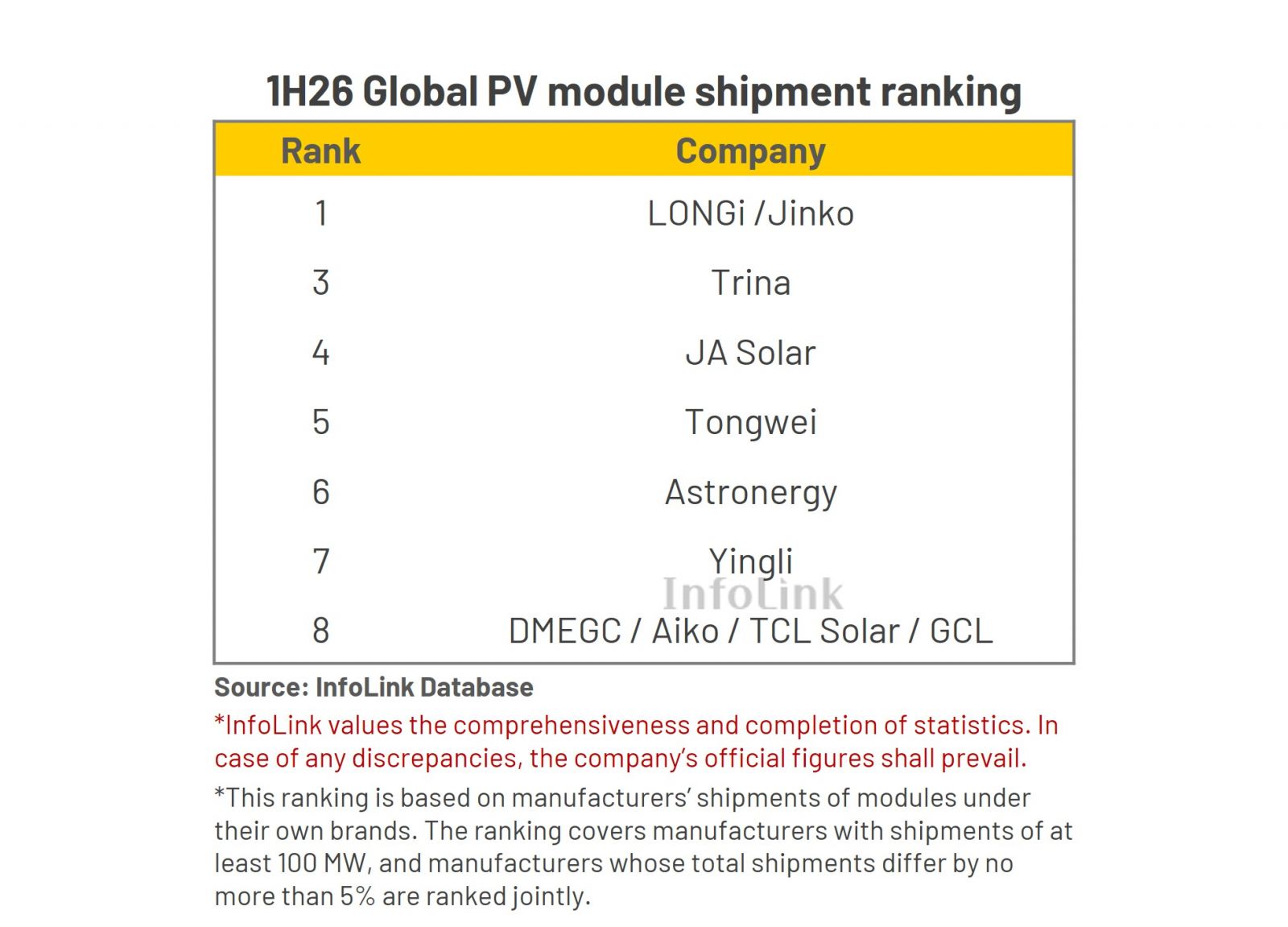
Ranked module suppliers ship approximately 181.39 GW in 1H26
According to InfoLink’s research, module suppliers included in the global ranking shipped approximately 181.39 GW in total in 1H26. As shipment volumes were closely clustered toward the bottom of the ranking, four suppliers tied for eighth place, bringing the actual number of companies on the list to 11.
Looking only at the top 10 suppliers, their combined shipments declined 31% YoY. A like-for-like (LFL) comparison of the eight suppliers included in the rankings for both 1H25 and 1H26 also shows a 30% YoY decline in combined shipments.
The first tier comprised LONGi and JinkoSolar , which tied for first place.
In the second tier, Trina Solar ranked third by a narrow margin, followed closely by JA Solar in fourth place.
In 1H26, the top four suppliers accounted for around 59% of total shipments by companies included in the ranking, establishing a clear shipment gap and lead over the remaining suppliers. However, the second tier is rapidly catching up with the first, with the shipment gap between the two narrowing by around 4–5% from a year earlier.
It should be noted that the shipment totals of all four leading suppliers include shipments from their U.S. module plants: LONGi’s total includes shipments from Illuminate USA; JinkoSolar’s includes shipments from Jinko Solar (U.S.) Industries, Inc.; Trina Solar’s includes shipments from T1 Energy Inc.; and JA Solar ’s includes shipments from American Panel Solutions (Corning).
The third tier comprised Tongwei, Astronergy, and Yingli Solar, ranking fifth through seventh, respectively.
In the fourth tier, DMEGC Solar, AIKO, TCL Solar, and GCL tied for eighth place, as their shipment volumes differed by less than 5%. With shipment volumes closely clustered, competition for ranking positions among fourth-tier suppliers continues to intensify.
For this ranking, TCL Solar’s shipment data include the following brands: HuanSheng, TCL Solar, TCL Photovoltaic Technology, SunPower, Maxeon, and DAS Solar.
Corporate competition, collaboration, and transformation amid ranking shifts
Three companies merit particular attention when examining changes in the rankings.
- Canadian Solar, a perennial presence in the rankings, fell off the list for the first time. Nevertheless, this does not mean that the company is losing its competitiveness. On the contrary, Canadian Solar has been one of the few Chinese PV manufacturers to remain profitable over the past three years. The company has sharpened its strategic focus on the U.S. market, and its U.S. PV cell plant recently began production. This reflects the company’s forward-looking positioning, with its strategy of pivoting toward high-value markets gradually beginning to bear fruit.
- AIKO entered the module shipment ranking for the first time. Despite being a long-established specialized cell manufacturer, AIKO bucked the broader trend and secured a leading position in the module shipment ranking by differentiating itself with its cutting-edge BC technology and, in particular, its all-BC module product strategy. It has thus become a representative example of a specialized cell manufacturer successfully transforming into a tier-one module supplier.
- In this ranking, TCL Solar represents the combined entity of two brands that previously ranked among the top 10—TCL Solar and DAS Solar. As the industry enters a plateau phase, the long-established specialized wafer manufacturer has filled its longstanding gap in cell capacity in one move through the acquisition of DAS Solar’s brand and production capacity. Meanwhile, the combined scale and market influence of the two brands have propelled TCL Solar to become the industry’s third-largest BC module supplier. With the acquisition and integration of DAS Solar drawing to a close this year, this ranking formally presents the combined shipments of the merged entity.
H1 shipment focus shifts significantly to non-Chinese markets as BC shipments post growth
Affected by the export tax rebate policy in 1H26 and a sharp decline in Chinese market demand, the global top 11 module suppliers shifted their shipment focus toward markets outside China. China accounted for approximately 39.9% of total shipments, while other markets accounted for 60.1%, with their share increasing by about 18 percentage points from 1H25.
By technology, TOPCon modules remained the core product across leading global suppliers.
H1 data indicates that TOPCon modules accounted for approximately 83% of shipments among the top 11 suppliers. For BC modules, in addition to AIKO, which entered the ranking this year, LONGi, JA Solar, TCL Solar, and GCL also recorded shipments. Total BC module shipments reached nearly 30 GW in H1, representing 16% of the total.
As for HJT technology, since major HJT manufacturers did not enter the top 10 ranking for the period, the data does not accurately reflect HJT’s actual share of the global market. Instead, it primarily illustrates the technology choices adopted by leading global module suppliers in their shipment strategies.
From market share to sustained competitiveness: The survival strategy of leading global module suppliers
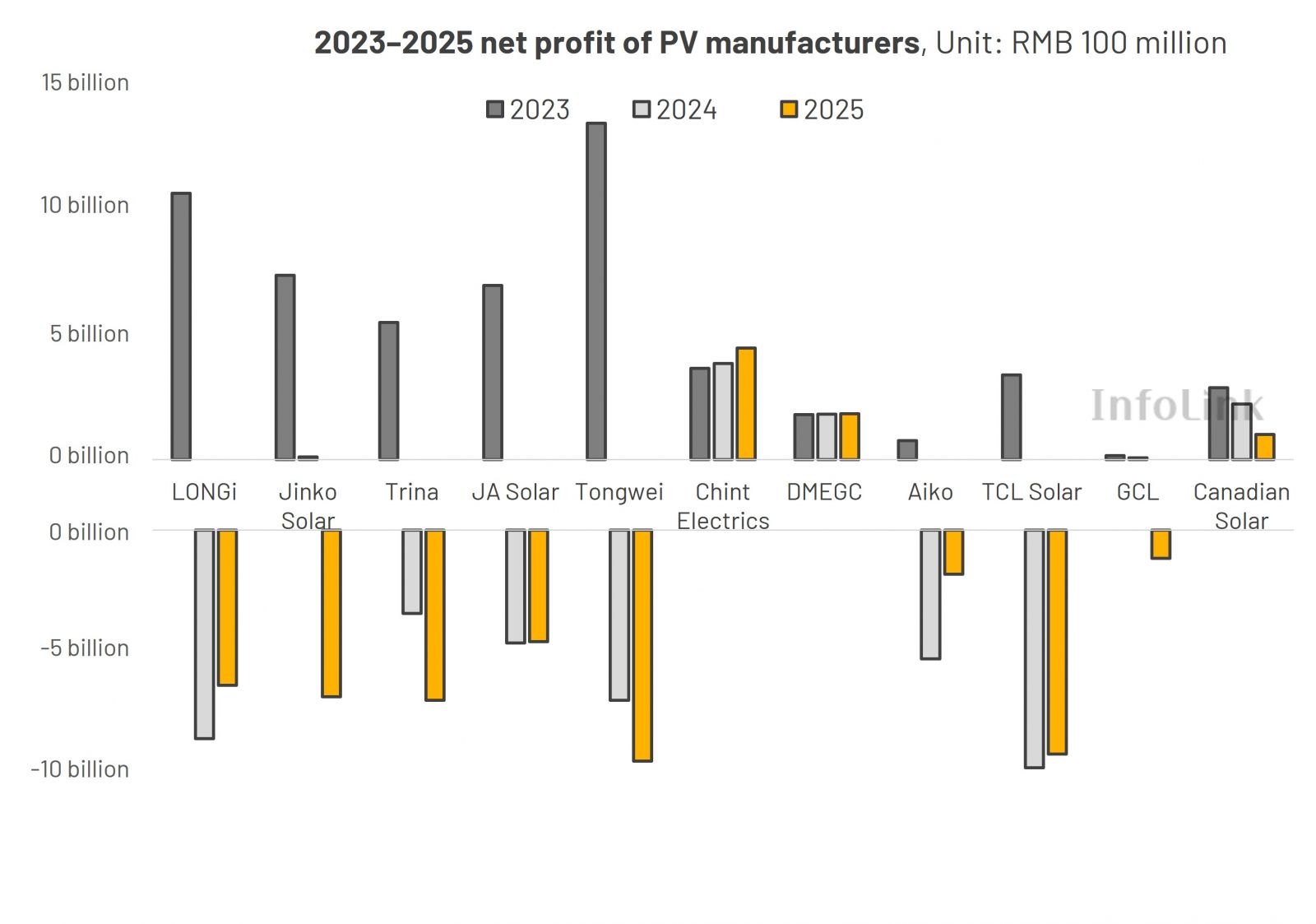
The PV industry is undergoing a structural adjustment. Supply-demand imbalance, overcapacity, and high inventory levels have slowed capacity rationalization. At the same time, end-market demand faces downward pressure. These conditions are prompting companies across the supply chain to accelerate technology upgrades and reinforce their core competitive advantages.
Entering 2026, the market has increasingly anticipated the implementation of China’s mandatory national standard, Minimum allowable values of energy efficiency and energy efficiency grades for crystalline silicon photovoltaic modules and inverters, further highlighting the product premium and competitive advantages of high-efficiency modules.
Previously, competition centered on expanding shipments and securing early-mover advantages. With most regional markets now broadly covered, the industry may need to reconsider how to leverage differentiated products to penetrate niche segments, align more closely with customer needs, and enhance long-term customer stickiness, thereby moving beyond product homogenization and price-led competition.
Companies that balance scale with profit—redirecting competition from price to value and transforming short-term shipment gains into durable competitive moats—will be best positioned to outperform in the next industry upcycle.
Ultimately, the PV industry is expected to transition from unchecked capacity expansion to a phase of high-quality development focused on energy efficiency and value creation.
**********
Global PV Customs Data Analysis Report
Learn more
**********
Acknowledgments: We would like to thank InfoLink Consulting in Taiwan for introducing us regularly to this useful article.