
PV column
energy
2026/02/19
Japan’s energy storage policy trend (by InfoLink Consulting)
In this column, we will introduce Japan’s energy policy from the perspective of overseas experts through an article titled “Japan’s energy storage policy trend: A concise analysis“, published on January 23, 2026 by InfoLink Consulting, a Taiwanese research and consulting company specializing in renewable energy and technology.
**********
Japan’s energy storage policy trend: A concise analysis
Since Prime Minister Sanae Takaichi has yet to release any energy-related policies, this article provides a concise analysis of Japan’s energy storage policy trends based on existing party political orientations, energy planning, and relevant policy measures.
Major parties’ energy policy positions
Japan’s energy policy is primarily shaped by the ruling coalition, subject to oversight by opposition parties. Under Prime Minister Takaichi, the government is setting Japan’s overall energy trajectory, prioritizing supply stability and energy security as core policy objectives. Central to this approach is the principle of “maximizing the use” of nuclear power, which is positioned as an indispensable baseload energy source. To this end, the government has been actively promoting the restart of existing nuclear reactors, while advancing the orderly development of renewable energy.
Opposition parties, on the other hand, play an oversight role while putting forward alternative policy proposals. The largest opposition party, the Constitutional Democratic Party of Japan, advocates a complete phase-out of nuclear power, emphasizing that its use should be strictly constrained until absolute safety can be ensured and the nuclear waste issue is fully resolved. The party also calls for an accelerated expansion of solar and wind power. Parties with more radical positions, such as the Japanese Communist Party, demand the immediate decommissioning of all nuclear power plants and achieving a society powered entirely by renewable energy.
In short, Japan’s current energy policy can be broadly characterized by two contrasting approaches: the ruling bloc’s stance of strengthening nuclear power without excluding renewables, and the opposition’s call for phasing out nuclear power to prioritize renewable development. Ultimately, policy direction is largely determined by the ruling coalition.
Evolution of Japan’s energy strategic plans
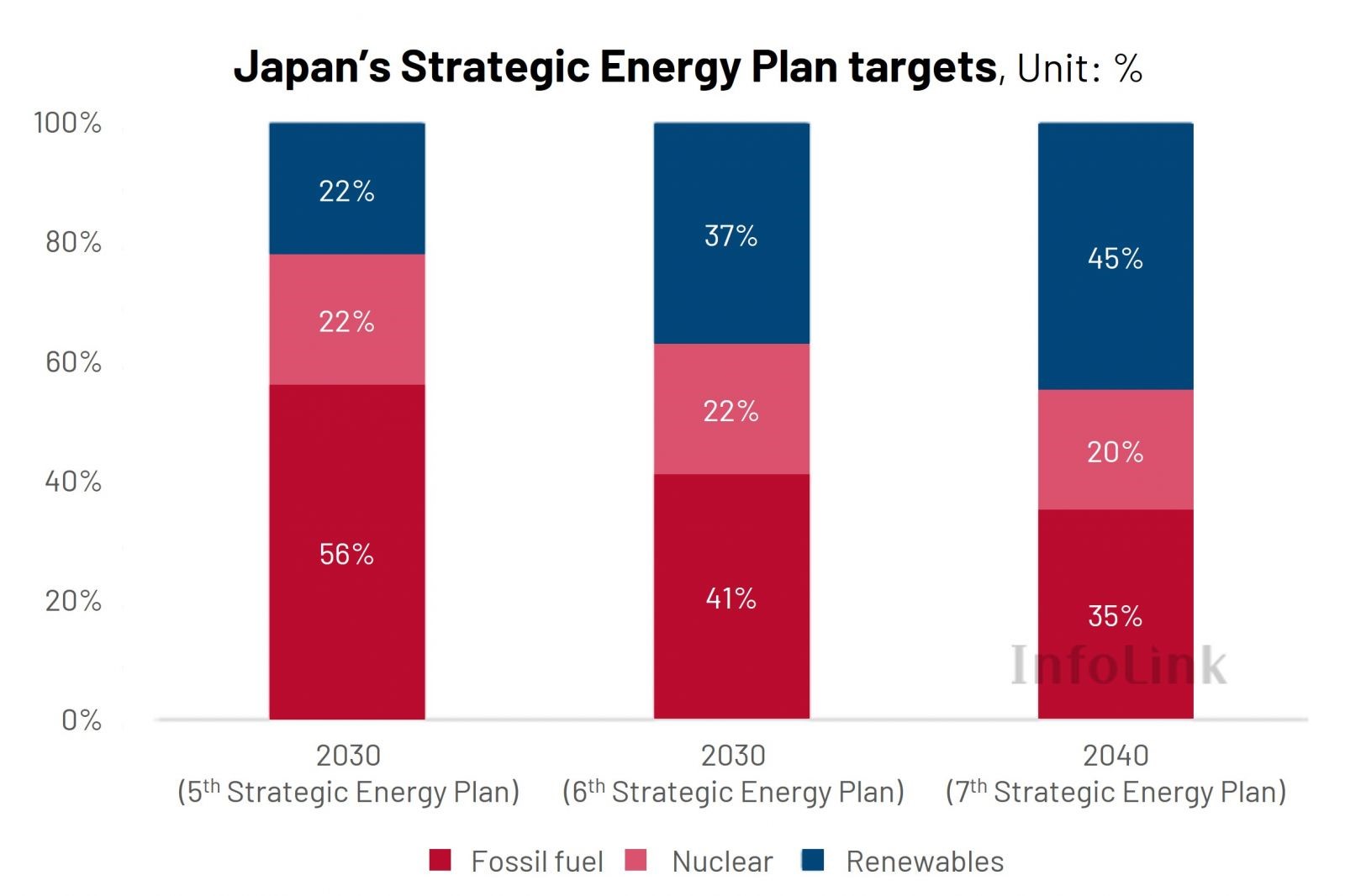
Japan’s Strategic Energy Plan is a national-level policy framework formulated under the Basic Act on Energy Policy of 2002 and revised every three to five years. The latest iteration—the Seventh Strategic Energy Plan, released in February 2025—calls for the construction of a highly resilient, autonomous, and dispatchable clean energy system. It establishes a development pathway centered on the “maximum utilization” of nuclear power alongside renewable energy, setting a target for renewables to account for 45% of the power mix by 2040.
This strategic direction must be understood in the context of its historical evolution. In the post-World War II period, Japan relied heavily on oil imports. Following the oil crises, policy shifted toward nuclear power and liquefied natural gas to diversify energy supply. After the Fukushima nuclear accident in 2011, Japan entered a phase marked by nuclear stagnation and the initial acceleration of renewable energy deployment. Today, amid mounting pressures from energy security concerns and decarbonization targets, policy has once again pivoted toward restarting nuclear power while advancing the systematic development of renewable energy.
From an energy storage perspective, as Japan raises its long-term renewable energy targets, the power system’s structural reliance on flexible balancing resources is expected to become increasingly pronounced. Energy storage demand is therefore expected to expand, playing a critical role in addressing renewable energy’s intermittency and volatility.
Figure 1. Japan’s Strategic Energy Plan targets:
Core policies shaping the energy storage market:
GX Promotion Strategy and GX 2040 Vision
In February 2025, the Japanese government released the Green Transformation (GX) Promotion Strategy and the GX 2040 Vision—two top-level national strategies aimed at achieving carbon neutrality by 2050. Both documents explicitly position energy storage as a priority emerging industry. Under these frameworks, the government plans to provide JPY 20 trillion (approximately RMB 881.8 billion) over the next decade—via bond issuance—to support green transition projects, including energy storage. In FY2024 alone, the government allocated JPY 8.5 billion (approximately RMB 375 million) to support the installation of energy storage systems. These measures indicate that Japan is not only elevating energy storage at the strategic level but is also strengthening policy support through tangible fiscal subsidies.
Source: Official website of the Japanese government
Long-Term Decarbonized Power Source Auction (LTDA)
Before Takaichi assumed office, the Japanese government had already begun shifting resource allocation and development priorities toward grid-side energy storage to enhance power system resilience. In June 2025, Japan revised its Long-Term Decarbonized Power Source Auction (LTDA) mechanism, a government-run auction scheme that provides eligible generation projects with twenty-year fixed capacity revenue guarantees. By the time the Takaichi administration took office in October 2025, Japan had already launched the third auction round.
Under the revised rules, long-duration energy storage was included as an eligible auction category for the first time. Additionally, the quota allocated to energy storage was reduced, while the minimum discharge duration requirement was increased to six hours. These changes signal a policy shift toward prioritizing long-duration storage in order to better align with grid-level flexibility and reliability needs.
Figure 2. LTDA auction:

Conclusion
At present, energy security remains the core guiding principle of Japan’s energy policy. Coupled with the medium- to long-term rise in the share of renewable energy, this creates significant opportunities for the energy storage industry. Looking ahead, Japan’s energy storage market is likely to exhibit the following characteristics:
- Technology pathway: The market emphasis is likely to shift toward long-duration energy storage.
- Functional positioning: Energy storage is expected to play a critical role in safeguarding grid stability and reliability.
- Market structure: Stricter technical thresholds and limited capacity quotas are likely to intensify competition across the industry.
**********
It seems that ordinary people in Japan have few opportunities to come into contact with information about renewable energy and energy storage systems (energy storage policy). Moreover, much of the news they see tends to emphasize impact on social media, image, and ease of understanding, and is often at odds with the original reporting content and actual statistical data.
We believe that this article, by an overseas specialist company introducing Japan’s energy policy, will be beneficial to the people of Japan in that it provides in-depth information and explains how overseas experts view Japan’s policy.
Acknowledgments: We would like to thank InfoLink Consulting in Taiwan for introducing us to this useful article.