
PV column
energy
2026/05/01
How domestic renewables can shield Europe from fossil fuel shocks (SolarPower Europe)
The Middle East crisis has brought increased attention to fossil fuels, and as a result, energy prices in Japan are also attracting attention. Similarly, as countries around the world are re-evaluating their energy policies, we can see articles evaluating renewable energy and energy storage systems, including battery storage facilities.
In this column, we will introduce “Solar and storage for EU energy security,” a report published by SolarPower Europe on April 1, 2026, as an example from Europe, a leading region in renewable energy and energy storage business models.
Source: https://www.solarpowereurope.org/insights/thematic-reports/solar-and-storage-for-eu-energy-security
**********
Solar and storage for EU energy security
Briefing Paper
1 April 2026
How domestic renewables can shield Europe from fossil fuel shocks
Amid renewed geopolitical tensions and volatility in global fossil fuel markets, EU energy security remains exposed to external supply disruptions and price spikes. Accelerating domestic power generation that is not reliant on imported fuels is therefore a strategic necessity.
This paper shows how solar PV, combined with storage and other flexibility solutions, can act as a powerful buffer for EU citizens and businesses by reducing energy price volatility and reducing import dependence. The analysis demonstrates that EU solar electricity is already delivering substantial savings on fossil fuel imports and protecting consumers from extreme price volatility. Further deploying solar and storage capacity across the EU will allow massive fossil fuel import cost savings in the future.
Key findings
- Solar PV is already saving the EU billions of euros in fossil fuel import costs during periods of geopolitical disruption.
- In 2026 alone, EU solar electricity generation is expected to avoid tens of billions of euros in gas imports, depending on gas price developments.
- Faster solar deployment would deliver additional savings and further reduce Europe’s exposure to supply shocks.
- Storage and flexibility solutions play a critical role in maximising the value of solar by shifting supply, shaving peaks, and limiting the impact of gas prices on power markets.
- Electrification of transport and heating, increasingly powered by renewables, is delivering additional structural reductions in oil and gas imports.
- Businesses can significantly reduce energy costs and risk exposure through solar PPAs, on-site solar, and battery storage.
**********
Introduction
Amid the escalating war in the Middle East, it is clear that accelerating domestic power generation that is not reliant on imported fossil fuels is fundamental to ensuring the EU’s economic resilience and energy security. Renewable energy, and solar PV with storage in particular, can act as a buffer, cushioning EU citizens and industry from energy price spikes and skyrocketing import costs that might otherwise have been even more severe.
EU gas prices, having crossed the 50 EUR/MWh bar in early March 2026, have increased 50% compared to last year and almost doubled compared to the previous month. Oil prices have also risen by 27%. Translated into euros: 10 days of war have already cost EU taxpayers an additional 3 billion EUR in fossil fuels imports.1 After 16 days, the additional bill stood at 6 billion EUR, according to President von der Leyen’s letter to the EU Council on 16 March.2
While electricity is cheapest during the day when solar output is the highest, in the early morning and early evening hours – when power demand is high and wind and solar output is low – coal- and gas-fired power plants must fill the gap. This leaves Member States vulnerable to swings in fuel prices, and peak consumption hours have become very expensive due to high gas prices. Earlier this month, wholesale power prices in Germany peaked at around 250 EUR/MWh in the early evenings, more than five times higher than midday levels, according to figures from ENTSO-E.3
Against this background, solar and storage can provide strong and quick relief to such emergency conditions. By producing cheap electricity locally and extending its availability beyond sunlight hours, solar and storage reduce the number of hours when gas sets the electricity price under the merit order system, resulting in lower price volatility. Further, the generation of solar electricity in the EU reduces the need to import fossil fuels from third countries, lowering the dependence on supply chains that can be subject to severe disruption, as being experienced in recent times.
The following section outlines how solar and flexibility support the EU to reduce its dependence on fossil fuel imports and shield from volatile energy prices.
1. Speech by the President: European Parliament plenary debate.
2. President von der Leyen’s letter to EUCO of 16 March 2026.
3. ENTSO-E Transparency Platform.
How can solar PV and storage shield the EU from fossil fuel price volatility?
1. How much fossil fuel import costs have been saved since the start of the Middle East war thanks to solar electricity generation?
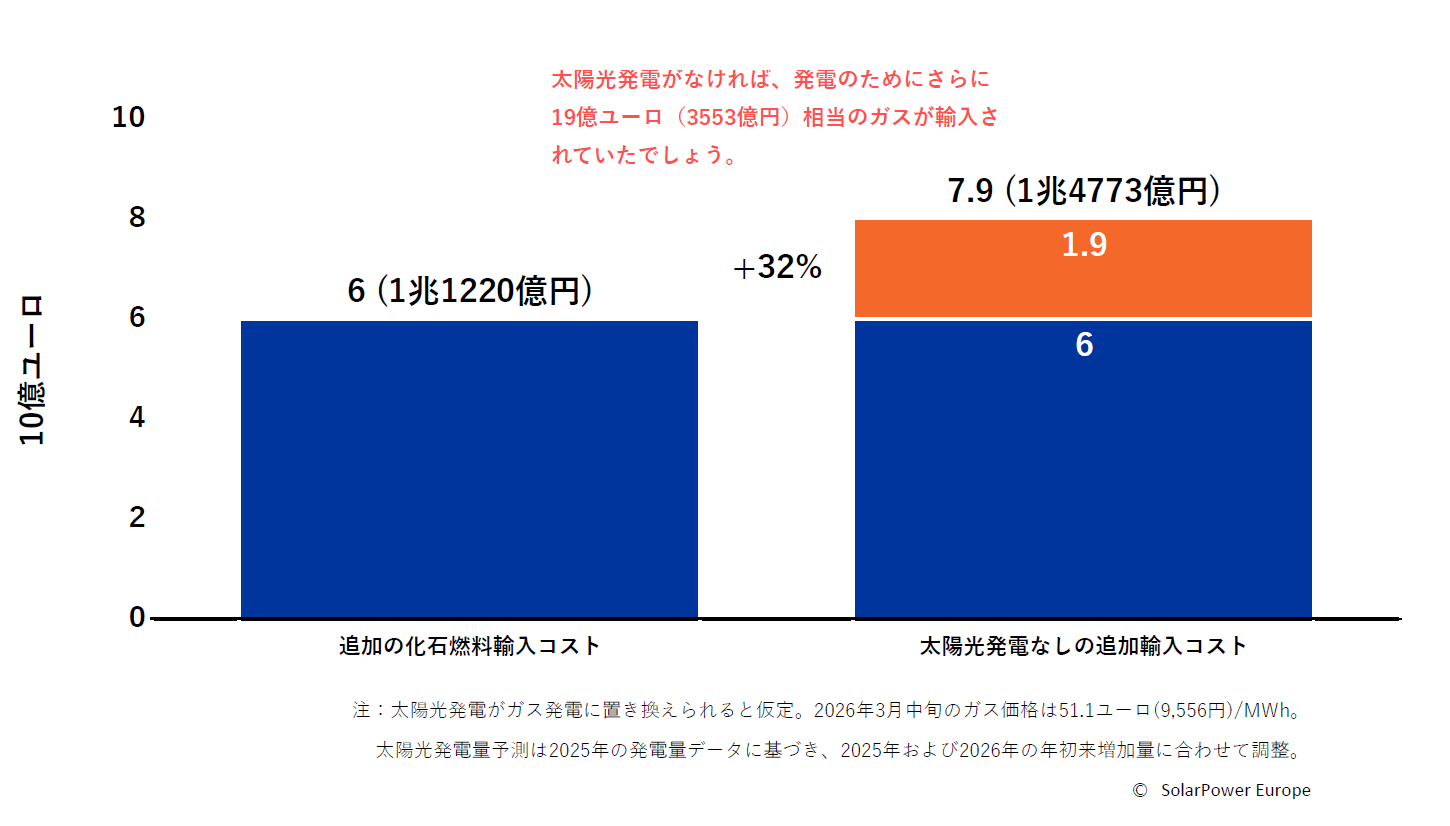
During the first 2.5 weeks of the war in the first half of March, EU installed solar PV generated around 19.9 TWh of electricity. If we had no solar in the EU, this electricity would have to be generated by other incumbent technologies. Assuming this demand would have had to be met by gas-fired power generation, it would have cost 1.9 billion EUR.
On 16 March 2026, European Commission President Ursula von der Leyen stated that since the beginning of the war, the EU had already spent an additional 6 billion EUR on fossil fuel imports. If we didn’t have solar electricity generation in the EU, we would have paid 7.9 billion EUR, which is 32% higher.
Find the latest figures on our daily tracker
Without solar electricity, the EU additional fossil fuel import bill since the war started would have been 32% higher
Figure 1. EU additional fossil fuel import costs and import costs without solar electricity generation, 1-17 March 2026
2. How much will be saved in 2026 as a whole thanks to solar generation?
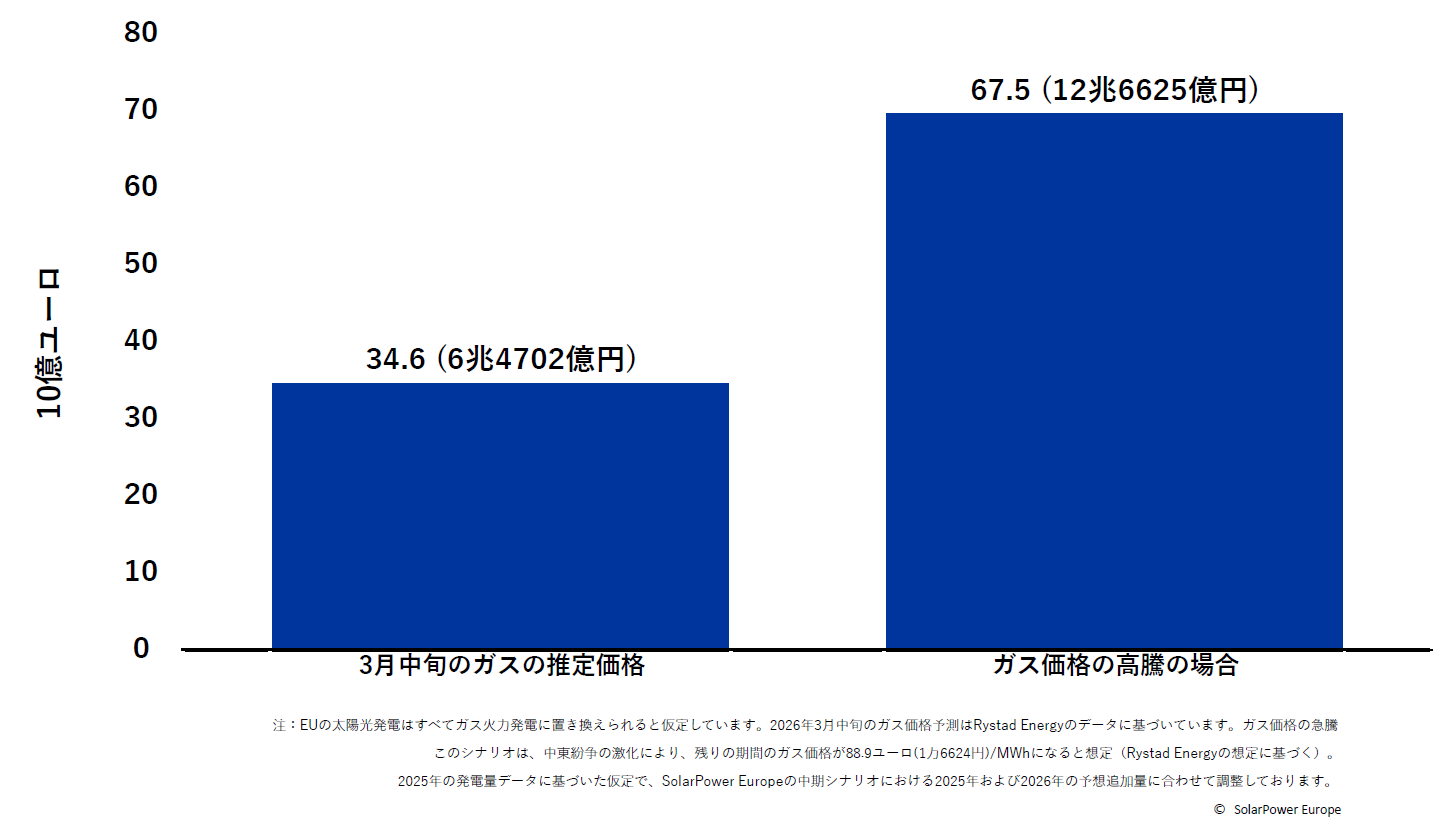
In 2026, the EU solar fleet is expected to generate around 415 TWh of electricity. Assuming that this would have to be produced by gas instead, it would cost 34.6 billion EUR in imports under current gas prices expectation as of mid-March 2026. With a prolongation of the conflict and more severe supply chain disruptions, resulting in a further surge in gas prices, the total import price bill would rise to 67.5 billion EUR.
EU solar electricity generation to save 35-68 billion euros in fossil fuel imports in 2026, depending on future gas price developments
Figure 2. import cost of replacing EU solar electricity with gas-fired generation in 2026
3.What is the role of storage and flexibility to reduce the impact of gas prices on consumers?
Flexibility plays a crucial role in decreasing the impact of gas price volatility on electricity prices. By maximising the usage of cheap solar electricity, shifting electricity supply to the period when it is most needed and shaving consumption peaks, flexibility solutions reduce the time gas sets the electricity price under the merit order system.
An analysis from Aurora Energy Research specifically highlights that battery storage, pumped storage, and hydroelectric assets provided the necessary flexibility to Spain and United Kingdom’s power system to minimise the impact of higher fossil fuel prices4. On the contrary, the Netherlands and Germany, more reliant on gas, saw their day-ahead daily market prices increase to a level twice as high as in Spain or the United Kingdom.
4. Aurora Energy Research Limited (2026): Value in volatility:
The impact of the Iran conflict on European power markets.
4. How much would be saved in fossil fuel imports in 2026 if this year’s PV deployment goes faster than expected?
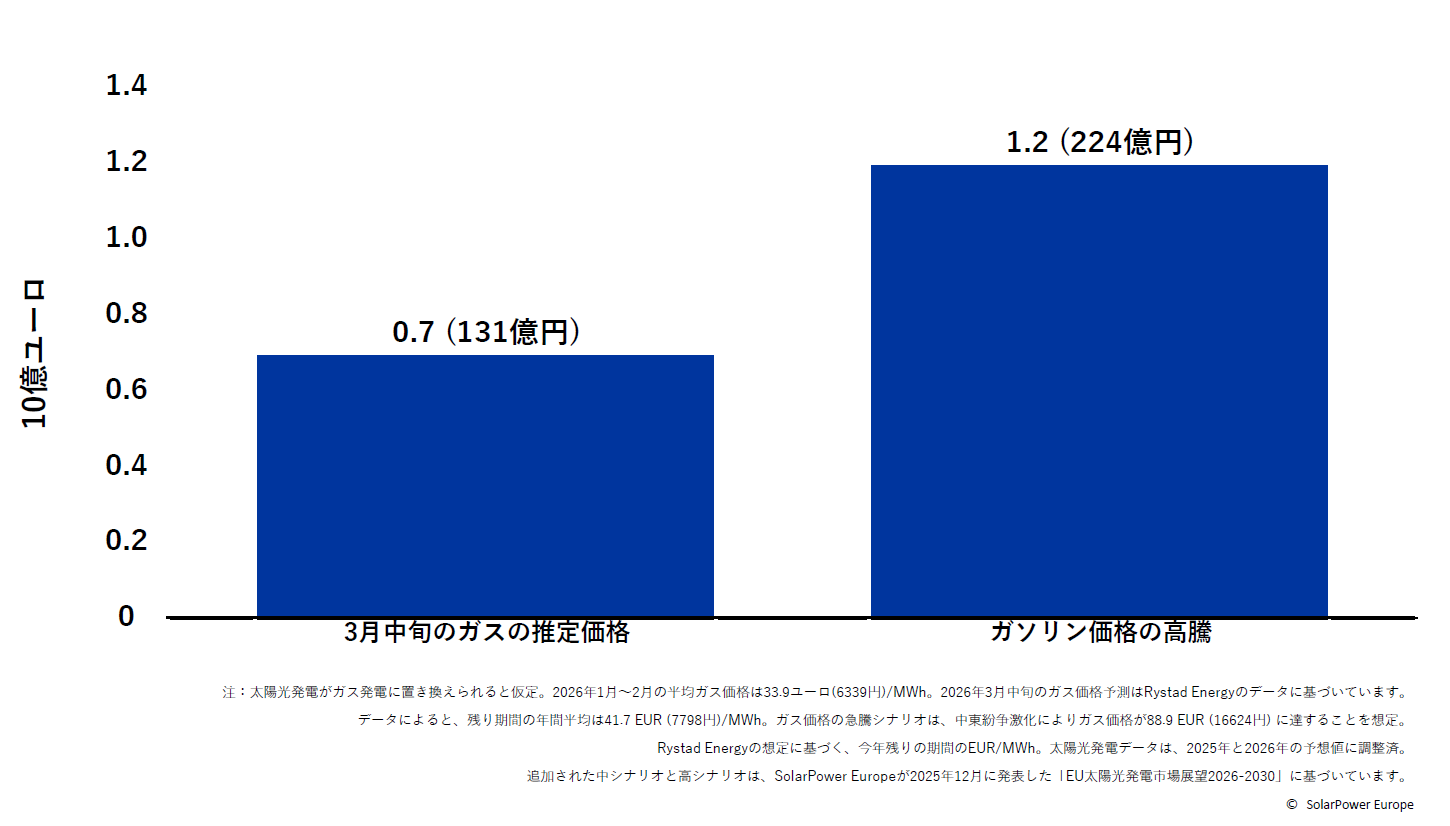
Under the current expectations for gas price developments for the rest of the year as of mid-March 2026, the EU would save an additional 719 million EUR in fossil fuel imports in 2026 if solar capacity installations follow SolarPower Europe’s High Scenario (70 GW) rather than the current trajectory, which assumes a slightly decreasing solar market due to lacking policy support (61 GW). This addition al capacity would generate more solar electricity and further reduce imports.
In the event of a conflict escalation and a further surge in gas prices to an average of 89 EUR/MWh for the rest of 2026, the value of avoided fossil fuel imports would increase to as much as 1.2 billion EUR in 2026 thanks to faster solar deployment.
An increase in solar capacity deployment in 2026 would lead to as much as 1.2 billion euros in saved gas imports, compared to the baseline scenario
Figure 3. Extra fossil fuel import cost saving if 2026 EU solar deployment meets the High Scenario rather than the Medium Scenario
5. How much will be saved in fossil fuel imports until 2030 thanks to solar electricity?
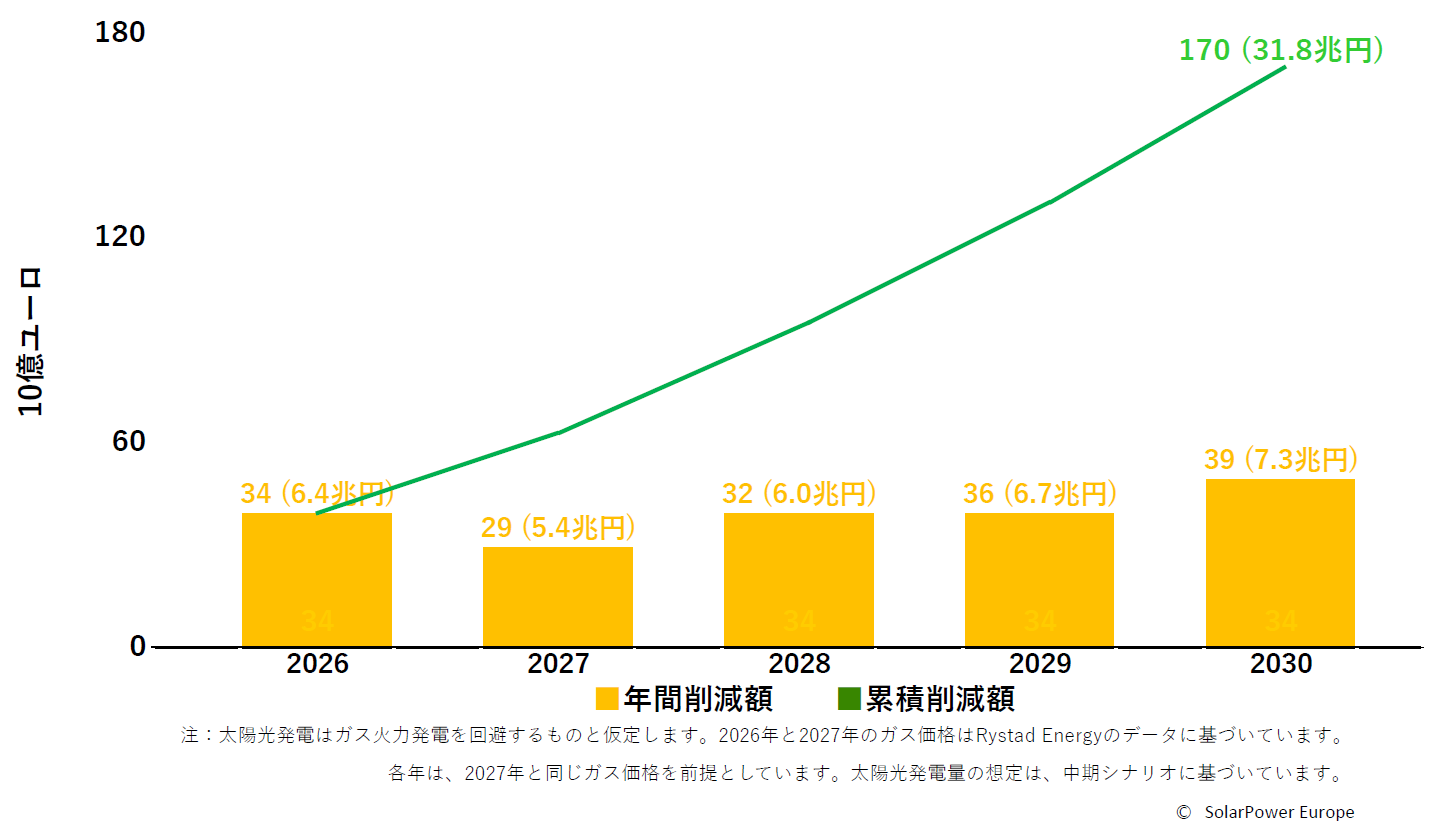
Under mid-March gas price expectations and PV deployment trajectory, solar electricity generation between 2026-2030 would avoid 170 billion EUR of gas import costs, assuming that gas would be used to generate that electricity instead. This represents average annual savings of 34 billion EUR, which is roughly the cost needed to install 34 GW, more than half of annual PV installations for this year.
EU solar electricity generation will avoid 170 billion euros in gas imports between 2026 and 2030
Figure 4. EU additional annual and cumulative gas import savings thanks to solar PV electricity generation, 2026-2030.
6. How much fossil fuel import costs were saved since the start of the Middle East war thanks to electrification of transport and heat?
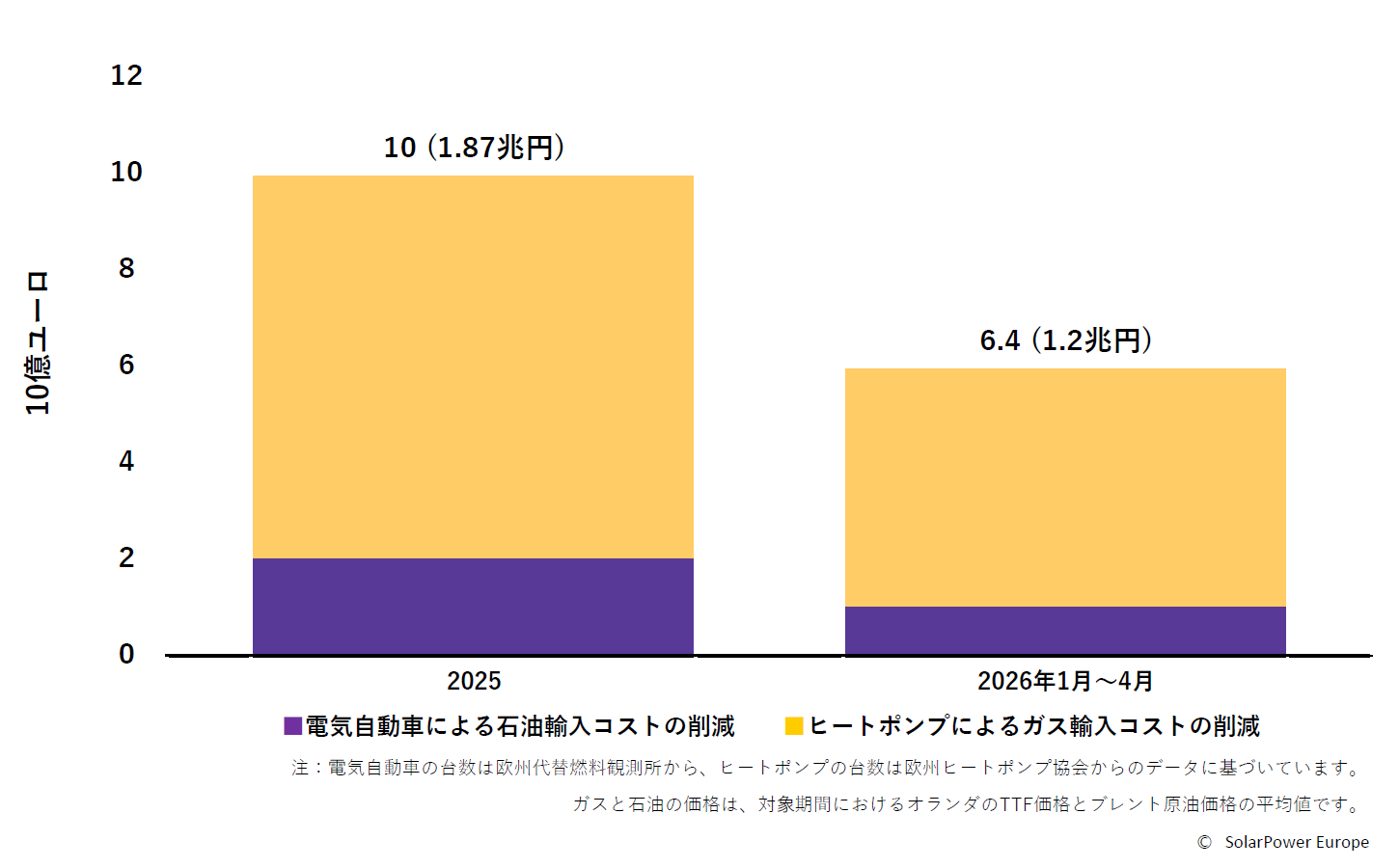
With a fleet of almost 8 million battery electric vehicles increasingly powered with RES electricity, the electrification of road transport already saved about 2 billion EUR of avoided oil import costs in 2025 and is expected to save 1.1 billion EUR between January and April 2026 alone. Similarly, the electrification of heating via heat pumps saved about 20 billion EUR in 2025, and is expected to save 5.3 billion EUR between January-April 2026.
Combined, it is already more than 6 billion EUR saved in 2026 alone thanks to electrification of heat and transport.
The electrification of transport and heat in the EU saved 10 billion euros in avoided fossil fuel imports in 2025, and over 6 billion euros in Jan-April 2026 alone
Figure 5. EU fossil fuels imports avoided thanks to electric vehicles and heat pumps
How can solar PV and storage support EU businesses during the energy crisis?
How much a business is directly impacted by wholesale power price volatility depends on its electricity market integration and ability to access hedging instruments on forward markets. Larger electricity consumers can be more directly exposed to the wholesale price, if they buy electricity directly on spot markets and are unable to find suitable hedging products in longer-term market timeframes.
However, most smaller businesses tend to pay the retail electricity price: retail power prices are contract-based, adjust with a lag and are partially hedged, so the immediate impact of the current conflict in terms of increased electricity bills is still uncertain. The smaller the size of the business, the smaller the direct impact and the larger the time-delay effect on the energy bill. Moreover, it’s hard to say whether retail prices will rise or stagnate at current levels over the next few months, stopping the downward trend since the height of the energy crisis in 2022, or if they will return to 2022 crisis levels. This will largely depend on whether LNG disruption via Hormuz persists into Q2 2026 and further conflict escalation leading to further damages to gas infrastructure occurs.
Taking the example of Germany, in January 2026 the average electricity price for new contracts for small to medium-sized industrial companies was at 16.0 EUR cents/kWh, down 1.6 EUR c/kWh from the previous year (attributed to the subsidy for transmission grid charges and a decrease in procurement costs), and 63% lower than prices at the height of the energy crisis in 2022 (43.3 EUR c/kWh).5 It remains to be seen how much this will grow in the coming weeks and months in light of the conflict escalation and supply chain disruptions.
Solar and flexibility for EU businesses
There are two main ways in which a business procures electricity from solar PV generation:
- Large energy consumers can sign a PPA contract, procuring a share of their electricity consumption from solar PV in the grid at a fixed price;
- Smaller energy consumers can generate and consume solar PV electricity from their own solar (and storage) installation.
In both cases, solar & storage already helps businesses to save on energy costs. Today, solar PV can further protect consumers from the harshest impacts of the sudden increase in gas prices, through increased savings.
Let us consider three scenarios: one base case, with power prices at pre-war levels, taking 2024 as a reference year, and two future pathways: one where gas prices remain at current (already high levels), and one case of conflict escalation in which gas prices increase to levels seen during the 2022 energy crisis. We outline each case below across two case studies from Germany.
Solar PV is Germany’s third-largest source of electricity, generating 18% of the total electricity mix in 2025, after wind power (27%), and coal (20%).6 Germany is the EU’s largest (and the world’s 5th largest) solar PV market, with more than 118 GW cumulative solar capacity in 2025. Since 2019, 3.4 GW of solar PV capacity have been signed in corporate PPA contracts in Germany7, allowing large-scale businesses to source solar PV at stable prices, as described in Case Study 1. Additionally, in the last four years, thousands of businesses have made the choice to install solar PV systems, often coupled with battery storage, to decrease reliance on grid-electricity. More than one-third of all solar PV in the country is installed in the commercial segment (systems larger than 250 kW), on large rooftops for businesses like the Schindele dairy farm, outlined in Case study 2. Solar PV in Germany today is powering the equivalent of 200,000 SMEs like this one.
5. Electricity price development in Germany for households and industry | BDEW.
6. Ember (2026).
7. RE-Source Platform: PPA deal tracker.
**********
You can download the report from the below link:
https://www.solarpowereurope.org/insights/thematic-reports/solar-and-storage-for-eu-energy-security
**********
Additionally, you can read a related article, an analysis report published by SolarPower Europe on April 1, 2026, titled “New Research: Solar Power Saves More Than €110 Million Per Day in Europe Since the Outbreak of the Middle East Conflict.” If you are interested, please refer to the link below.
**********
By the end of 2025, PV facility’s installation in Japan will have a cumulative capacity of approximately 80 GW. Although the construction cost of PV plants is decreasing year by year, if we simply assume a construction cost of 300K JPY/kW, then 1 MW would cost 300 million JPY (300K JPY/kW x 1,000 kW), and 1 GW would cost 300 billion JPY (300 million JPY/MW x 1,000 MW). Therefore, the cumulative construction cost for 80 GW can be estimated at 24 trillion JPY.
Meanwhile, Europe’s cumulative installed capacity is approximately 400 GW, about five times that of Japan. The annual reduction in gas prices in Europe is 34.6 billion euros (approximately 6.47 trillion JPY), so if Japan’s cumulative installed capacity is equivalent to one-fifth of that, it can be estimated that the effect would be 1.3 trillion JPY.
Unlike natural gas, which has a diversified range of import sources, the vast majority of oil imports come from the Strait of Hormuz and the Middle East, which are currently receiving a lot of attention. We believe that the use of electricity generated from PV facilities will bring far-reaching benefits to Japan as a whole, due to the increased adoption of electric vehicles and EV trucks, and the reduction in oil consumption at oil-based thermal power plants.
As a PV specialized company, we will continue to work on the introduction and utilization of PV and energy storage systems, while making the most of the unique characteristics of each energy source.
Acknowledgments: I would like to express my gratitude to SolarPower Europe and all those involved for publishing various comprehensive reports on PV industry.