
PV column
consulting
2025/12/18
Commission proposes upgrade of the EU’s energy infrastructure to lower bills and boost independence (by European Commission)
In Japan, the FIT Act, enacted in 2012, has significantly increased renewable energy generation capacity, primarily through the introduction of solar (photovoltaic) facilities (approx. over 70 GW as of December 2025).
Because both solar and wind power are variable renewable energy (VRE) and dependent on weather conditions, various proposals have been put forward regarding the utilization of existing grid capacity and surplus power generation. While Japan appears to be operating with less output control capacity than other countries, recent discussions seem to have focused on grid-connected energy storage facilities.
In this column, we will introduce “Commission proposes upgrade of the EU’s energy infrastructure to lower bills and boost independence” announced by the European Commission on December 10th in Europe, a country that is leading the way in introducing renewable energy and creating systems for it.
Source: https://ec.europa.eu/commission/presscorner/detail/en/ip_25_2945
PDF version: https://ec.europa.eu/commission/presscorner/api/files/document/print/en/ip_25_2945/IP_25_2945_EN.pdf
**********
Press release | Dec 10, 2025 | Brussels
Commission proposes upgrade of the EU’s energy infrastructure to lower bills and boost independence
The backbone of European energy system, the grids infrastructure, will be modernised and expanded to unleash its full potential. The Commission’s European Grids Package and the Energy Highways initiative, proposed today, will enable energy to flow efficiently across all Member States, integrating cheaper clean energy and accelerating electrification. This will help lower energy prices and support affordable living for all Europeans. It will ensure secure and reliable supply as Europe moves away from Russian energy imports to achieve energy independence.
The Grids Package marks a new approach to energy infrastructure by bringing a truly European perspective on infrastructure planning, while accelerating permitting procedures and ensuring a fairer division of costs regarding cross-border projects. The new approach will allow the best use of our existing energy infrastructure and, in parallel, accelerate the development of grids and other physical energy infrastructure across the EU.
Figure 1. European energy infrastructure projects of multilateral interest
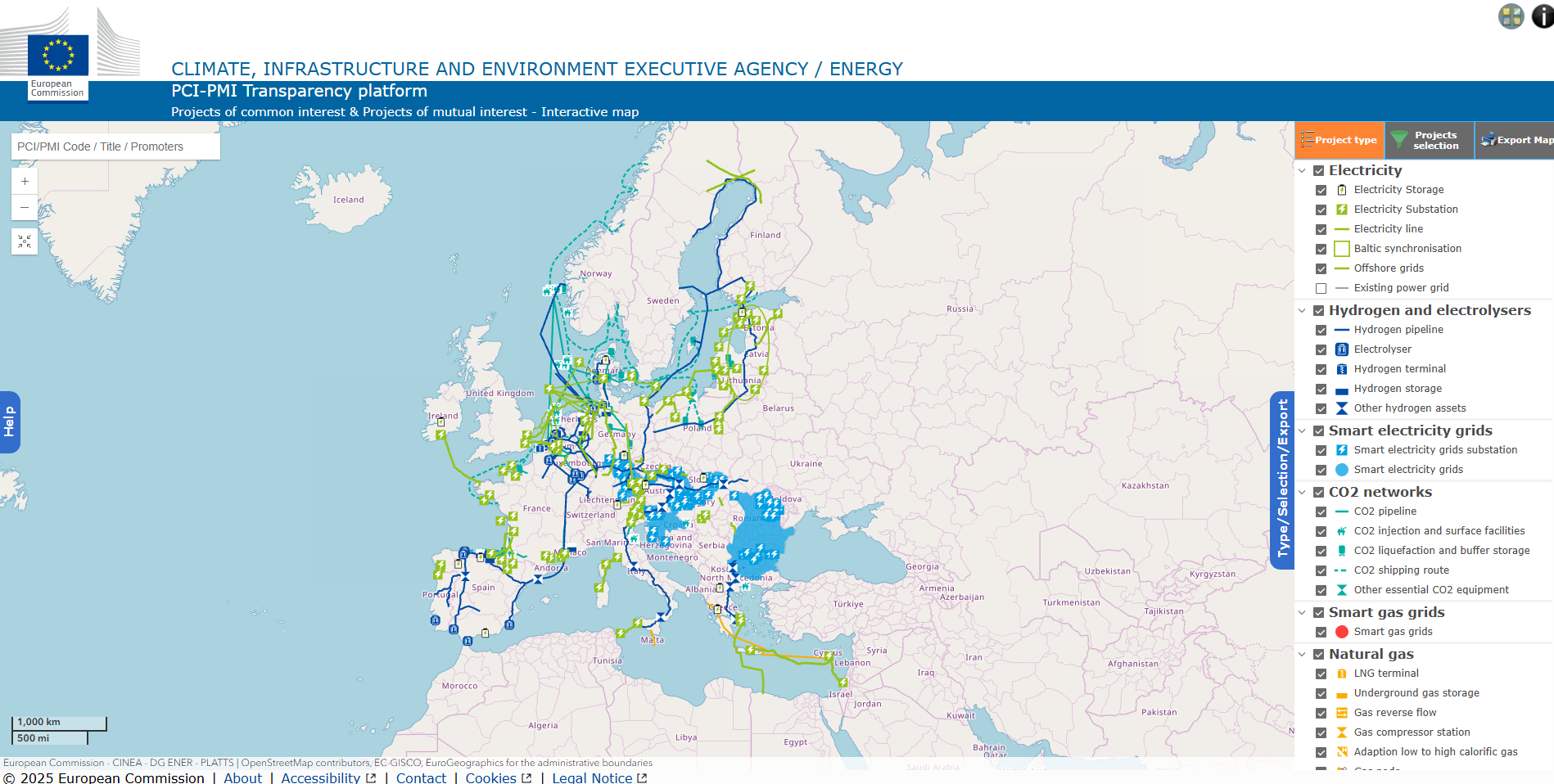
To future-proof the grid infrastructure, the Commission is proposing additional ways of financing. Cost-sharing and bundling are such examples: increasingly integrated cross-border energy infrastructure deliver benefits beyond the territories where they are built. This makes fair and transparent cost-sharing essential to avoid disproportionate burdens on local consumers. To tackle this, the European Grids Package aims to provide more transparency and fairness in the way costs and benefits are assessed. Bundling infrastructure projects can also make financing easier, for example through the establishment of special purpose vehicles, thereby attracting additional investment.
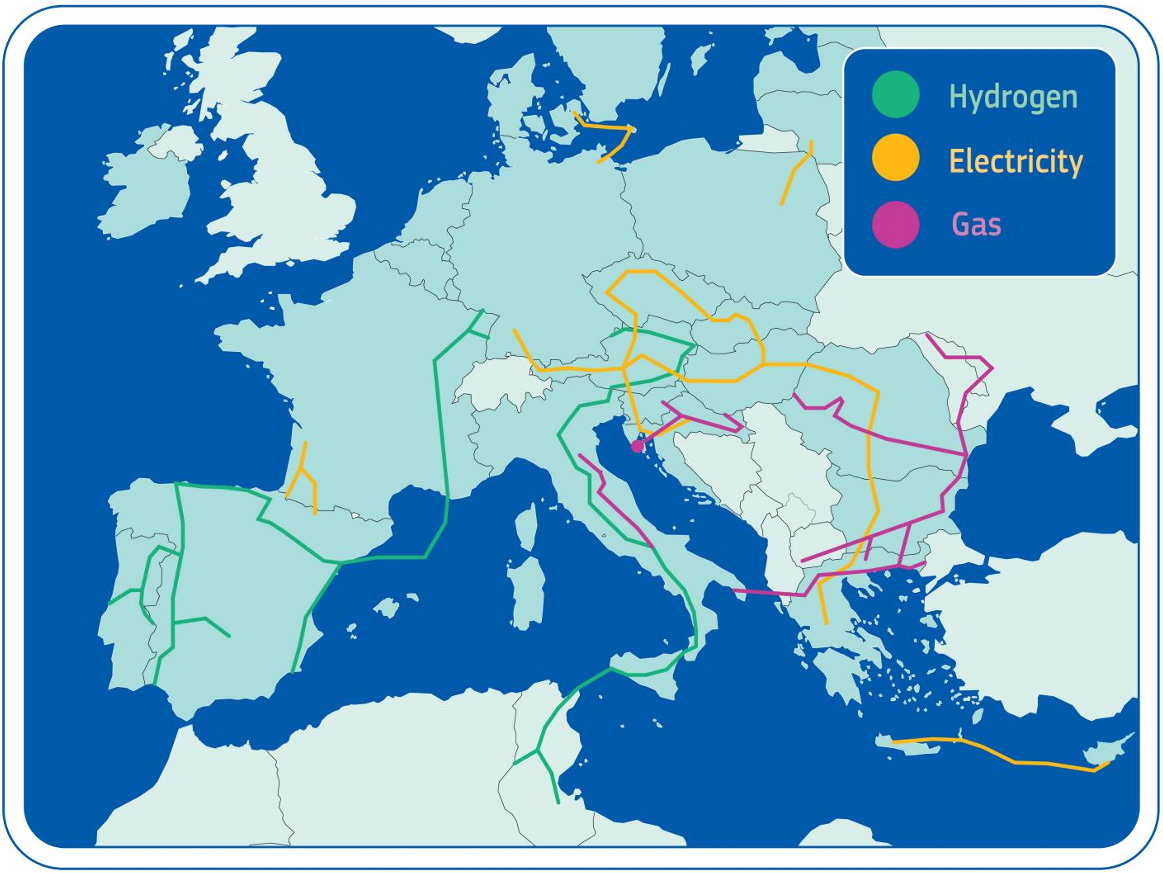
Announced by President Ursula von der Leyen in her State of the Union 2025, the 8 Energy Highways address the most urgent infrastructure needs that require additional short-term support and commitment for implementation. They were selected based on their strategic importance to complete the Energy Union and on the level of political support from the EU needed for their successful implementation
The Commission is committed to immediately fast-tracking the Energy Highways through enhanced political coordination, drawing on the Regional High-Level Groups, mobilising support of European coordinators and working closely with the Energy Union Task Force, extending outreach beyond EU Member States where necessary. Each project will be prioritised at EU level, and the Commission will support Member States in giving them the same priority nationally.
Next steps
The legislative proposals will now pass to the European Parliament and the Council under the ordinary legislative procedure. In parallel, the Commission will continue collaborating closely with Member States and all relevant stakeholders to implement key cross-border energy infrastructure projects – as recently published under the second Union list on Projects of Common Interest and Projects of Mutual Interest. Such collaboration will be pivotal in view of delivering swiftly on the Energy Highways initiative, as well as on the acceleration of permitting for renewable energy projects, storage projects and recharging stations.
Background
Despite the progress achieved within the current EU legal framework, the EU has not reached the level of interconnectivity among Member States that would enable a genuine Energy Union, as several Member States are not on track to meet the 15% interconnection target by 2030. The cost of inaction is staggering: in 2022, fossil fuels had the largest share of gross available energy use (70%) in the EU, with 98% of all oil and gas used in Member States being imported. This exposes the EU to price volatility and geopolitical risks.
In 2024, industrial electricity prices in the EU reached €0.199 per kWh, compared to €0.082 in China and €0.075 in the US. In the first half of 2025, the average electricity price for EU consumers varied from €0.3835 per kWh in Germany to €0.1040 per kWh in Hungary, while non-household electricity prices ranged from €0.2726 per kWh in Ireland to €0.0804 per kWh in Finland. A key reason for this disparity is the insufficient level of investment in and integration of our infrastructure.
Scaling up financial support is hence key. As part of the 2028-2034 Multi-annual Financial Framework, the Commission proposed a five-fold increase of the CEF Energy budget from €5.84 billion to €29.91 billion. Public funding will be complemented by actions to leverage private investments in the upcoming Clean Energy Investment Strategy.
For more information
Questions and answers
Factsheet
Communication on European Grids Package – Energy – European Commission
Proposal for revised Trans-European Network for Energy (TEN-E) Regulation – Energy
Proposal for revised Directive to accelerate permit-granting procedures of infrastructure projects – Energy
Guidance on efficient grid connections – Energy – European Commission
Guidance on Contracts for difference – Energy – European Commission
European grids – European Commission
PCI interactive map
**********
For your reference, the following is a summary of the analytical data (the Factsheet mentioned above) related to the European Commission’s proposal.
The European Grids Package modernises and expands the backbone of European energy system, the grids infrastructure. By replacing barriers and bottlenecks with fast-flowing energy highways and cross-border connections, the Grids Package will help lower energy prices and support affordable living for all Europeans. A new, truly European approach on infrastructure planning will allow the best use of the existing energy infrastructure and accelerate the development of grids and other physical energy infrastructure across the EU.
Not fully interconnected
- 45%: 45% of cross-border electricity capacity needs will remain unaddressed by 2030
- 15%: Many Member States are not on track to meet the 15% interconnection target by 2030
- €5.2 billion: Costs from grid congestion reached €5.2 billion in 2022, and could rise to €26 billion by 2030
- 310 TWh: By 2040, up to 310 TWh of renewable energy could go to waste — nearly half electricity consumption in 2023
Fully interconnected
- €34 billion: European consumers already benefit from around €34 billion every year thanks to the EU’s internal energy market
- €40-43 billion: Further integration could raise such benefits up to €40-43 billion per year already by 2030
- €3 billion: Investing €5 billion would reduce system costs by € 8 billion, creating a net economic gain of €3 billion
- +50%: Boosting cross-border electricity trade by 50% could raise annual EU GDP in 2030 by around €18 billion
With the European Grids Package and the Energy Highways, the EU will have an energy system that is fully interconnected, enabling clean, affordable, homegrown energy to flow freely and securely across the EU.
A common European project for the common European good
- Greater direction and coordination at EU level to map and plan the grids infrastructure.
- Enhance security and resilience of physical energy infrastructure.
- Speed up and streamline permitting processes for renewable projects, while ensuring public acceptance and benefit-sharing.
- Make existing infrastructure more efficient, reinforced by new technology, flexibility, and storage capacity.
Fast-track the Energy Highways
These key strategic projects address the most urgent infrastructure needs that require additional short-term support and commitment for implementation to support the completion of a genuine Energy Union.
Figure 2. The map of Energy Highways
The EU has a population of approx. 450 million and an economy of approx. $20 trillion, while Japan’s population (approx. 120 million) and economy ($4 trillion) are roughly one-quarter of the EU’s. If we evaluate Japan’s energy budget based on this ratio, the multi-annual budget (six years) from 2028 to 2034 would be estimated at between 1.46 billion euros (approx. 270 billion yen) and 7.478 billion euros (approx. 1.3647 trillion yen).
Japan’s Ministry of the Environment has set aside 200 billion yen (for fiscal 2025) for GX promotion measures, and the Ministry of Economy, Trade and Industry and other ministries also have budgets for energy conservation and decarbonization, so I feel that the budget scale is comparable to that of the EU. Similarly, it is not surprising that the resulting benefits accrue to Japan may reach 8.5 billion euros (1.55 trillion yen), a quarter of Europe’s 34 billion euros (6,205 billion yen) per year.
We will continue to pay close attention to the outcomes of future energy policies in Europe and Japan.
Acknowledgments: We would like to thank the European Commission for publishing this interesting article on energy and infrastructure.